
PPS+ or PPLNS: What Each Settlement Path Costs at Your Hashrate
The choice between PPS+ and PPLNS is a choice about who absorbs a bad hour. At 2,320 TH/s the daily output is 0.00104077 BTC, which is $88.14 at $84,692 per coin, and the listed rate on the block-reward component is 4% against 2% for the PPLNS-distributed parts. Those two facts are enough to price the decision, provided the variance side is priced honestly too.

Key takeaways
- At 2,320 TH/s the output is 0.00104077 BTC a day, or $88.14 at $84,692 per BTC.
- The listed 4% on the block-reward component costs $3.53 a day at that output.
- The listed 2% on the PPLNS-distributed components costs $1.76 a day on the same base.
- PPS+ pays hourly; PPLNS pays after 6 confirmations across the last 5 difficulty rounds.
Two paths, one output
PPS+ is the default and it settles the block-reward component hourly against current difficulty. PPLNS waits until a block has 6 confirmations, then shares the miner's slice over the last 5 difficulty rounds. The coins produced are the same in expectation. What differs is when they arrive and who carries the risk that the pool has a slow hour.
That is the whole trade in one sentence, and it is why the rates differ. The higher listed rate on the block-reward side purchases certainty. A miner who wants a number that can be entered into a budget on Monday and still hold on Wednesday is paying for the smoothing. A miner with a large enough operation to absorb a flat week can take the lower rate and the variance with it.
The schedule, component by component
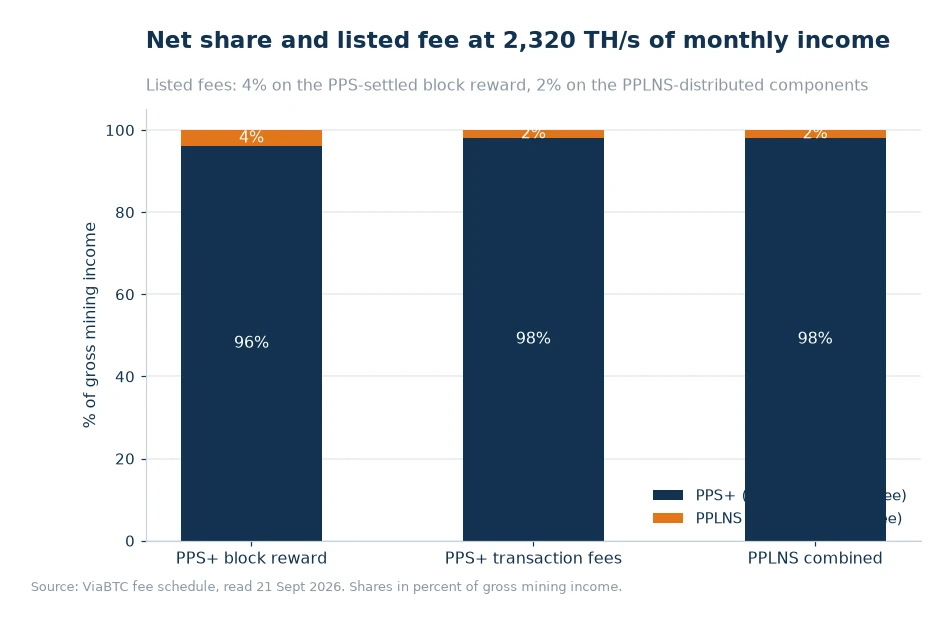
The table lines up the three pieces that matter at 2,320 TH/s. The cost column applies each listed rate to the full daily output so the sizes are comparable; in practice the 2% applies only to the fee component inside PPS+, or to the combined total under PPLNS.
| Scheme and component | When it settles | Listed rate | Cost per day |
|---|---|---|---|
| PPS+ block reward | Hourly, current difficulty | 4% | $3.53 |
| PPS+ transaction fees | PPLNS logic inside PPS+ | 2% | $1.76 |
| PPLNS combined | After 6 confirmations, 5 rounds | 2% | $1.76 |
Read the first and third rows together and the decision becomes concrete: $3.53 against $1.76 a day at this hashrate, a difference of $1.77. Over thirty days that is $53.10. Whether the certainty is worth $53 a month depends on the size of the operation and on how much a low week would hurt, which is a question no table can answer on its own.
What variance is worth to a small miner
For a single machine, variance is mostly an emotional cost. The daily number wobbles, the miner checks it twice, and the difference over a month is small in absolute terms. For an operation paying a fixed hosting invoice every month, variance becomes a cash-flow problem: a slow week and a rent cheque can land in the same seven days. That is when the higher rate earns its keep.
The reverse case is a miner with low overheads and no debt against the hardware. There, a lower listed rate and a wider swing is usually the better trade, because the bad weeks arrive when nothing else is due. The scheme is not a moral choice or a signal of sophistication; it is a match between a payment pattern and a set of obligations.
Reading the schedule without shortcuts
The ViaBTC Pool Fees page lists the two schedules in full, and it is worth reading the component labels rather than skimming the percentages. Two rates on two bases behave very differently from one rate on everything, especially when transaction fees are a thin slice of the block. Anyone who quotes a single combined number is describing a product that does not exist here.
One consequence is easy to miss: as fee income grows relative to the block reward, the blended cost falls slightly, because more of the payout is being charged at 2% rather than 4%. A busy chain is therefore mildly cheaper under PPS+ than a quiet one at the same hashrate. The effect is small, but it runs in the opposite direction to most people's intuition about congestion.
One line is deliberately absent from the comparison: the withdrawal charge. Mining payouts on the pool are zero-fee, so moving credited coins to an exchange or a hardware wallet does not add a second percentage to the arithmetic above. That matters most at small hashrates, where a flat withdrawal fee would otherwise dominate a month of earnings and make the 4% against 2% question look trivial by comparison. Check the receiving side anyway, because a deposit address can carry its own costs, and those belong on a different sheet from the mining fee.
Worked example
Everything below comes from the network figures, not from a dashboard.
- Daily network output: 3.125 BTC per block × 144 blocks = 450 BTC.
- Per TH/s: 450 ÷ 1,003,107,267 = 0.000000448606 BTC.
- At 2,320 TH/s: 2,320 × 0.000000448606 = 0.00104077 BTC.
- At $84,692: 0.00104077 × 84,692 = $88.14.
- Listed 4% on the block-reward component: 88.14 × 0.04 = $3.53.
- Listed 2% on the fee component: 88.14 × 0.02 = $1.76.
- Difference over 30 days: (3.53 − 1.76) × 30 = $53.10.
Note what the last line does not say. It does not say PPLNS is $53 cheaper, because the 2% applies to a smaller base inside PPS+ and the two schemes do not charge the same money. It says the spread between the two rates, applied to the same daily output, is about $53 a month. The true gap is smaller, and any comparison that ignores the base is overstating its case.
Switching schemes without losing a week
Changing payout mode is not instant bookkeeping. Under PPLNS the miner's share depends on the last 5 difficulty rounds, so a switch mid-window means part of the history was earned under a different arrangement. Expect a transition period where the numbers look odd, and do not read it as a fault. Note the date of the change and compare the following full week rather than the straddling one.
The same applies to difficulty adjustments. The next estimate at the time of writing was −2.12%, which would lift output per terahash slightly if it lands. A scheme comparison run across an adjustment boundary will pick up that change and attribute it to the scheme. Run the comparison on a stable stretch, or normalize both weeks to the same difficulty before drawing a conclusion.
Frequently asked questions
Which scheme pays more at 2,320 TH/s?
Expectation is the same before fees, and the difference is the rate: the listed 4% costs $3.53 a day on the block reward against $1.76 for the 2% components, with PPS+ buying hourly certainty.
How long does a PPLNS payment take to arrive?
A PPLNS block pays after 6 confirmations, and the miner's slice is measured across the last 5 difficulty rounds rather than the hour the block was found.
Can I change payout scheme later?
Yes, and the account keeps the same wallet and address, but the first week after a switch spans two arrangements, so judge the change on the following full week.
Match the scheme to the invoice
Look at what falls due each month and let that decide. Fixed hosting fees, loan repayments and equipment finance all reward a predictable credit, which points toward PPS+. Low overheads and a tolerance for swing point the other way. Neither answer is permanent, and the cost of being wrong is a few tens of dollars a month at this hashrate, not a catastrophe.
Write the decision down with the date, the hashrate and the daily figure you were earning when you made it. Six months later, when difficulty has moved and the argument is being had again, that note is worth more than the recollection of why it seemed obvious at the time. The pool state page will show whether the pool's own luck has been kind, which is a useful sanity check on any strong opinion about variance.
If the decision needs a number rather than an opinion, the Profit Calculator will produce the daily credit at your hashrate under the current difficulty, and the table above shows how to translate it into a monthly difference between the two schemes.
Sources: the ViaBTC pricing page for the listed 4% and 2% and for settlement terms[1]. Chain data read 21 Sept 2026: network hashrate 1,003 EH/s, difficulty 132.76 T, subsidy 3.125 BTC per block, 144 blocks a day, BTC $84,692, next difficulty estimate −2.12%. Published 22 Oct 2026.